
On art and aftermaths

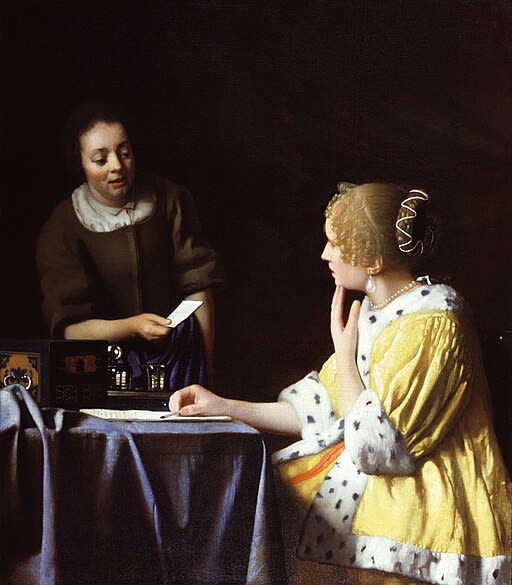
This July, during a trip to New York, I lined up along with everyone else in the city to visit the new Frick Collection, which happened to be showing three paintings that had never been seen together, by the great Dutch painter Vermeer. In my favourite, Mistress and Maid (1664-67), a maid hands the mistress a letter and the mistress, decked out in fur and a yellow robe, draws her hand to her chin, her face suffused with concern, or even horror.
In the painting, rendered in Vermeer’s signature jewelled colours, the circumstances that have led to this moment are less important than their emotional consequences and in focussing, not on the grand events that inspired the woman’s reaction, but in the way the aftershock is registered by the subject’s body, he is telling us something about what warrants close looking.
How an ordinary gesture—a fleeting glance between two women—can telegraph a universe of emotion. Carry a greater psychological weight than the story not pictured, the events beyond the grasp of the viewer, outside the frame.
There’s plenty more I could say about Vermeer. How his images of women are also portraits of quiet absorption. About how, as Teju Cole put it in this brilliant New York Times essay the intimate scenes he focused on—the studies and kitchens and drawing rooms—are also implicated in the Dutch Golden Age, the invisible threads that link the luxury objects he painted (the ornate writing set in Mistress and Maid!) to sites of empire and conquest.
But this element of the painting speaks to something that I’ve been grappling with for the last couple of years, as I’ve worked on my first book, Foreign Return: On Art and Inhabitation, a work of literary nonfiction which will be out in August 2026 with NewSouth Publishing, who have published so many writers and thinkers I admire.
Thank you, too, for all the kind words and support from friends and colleagues and readers, it has meant a lot to me—I had not prepared myself emotionally for something that I’ve been working on privately to meet the world, how different and vulnerable this would feel from the other work I’ve been publishing for 15 (!) years.
Early in the process of working on the manuscript, I was thinking a lot about how to write about events and ideas that aren’t typically assigned dramatic value. Or how to render a narrative, not in terms of beginnings or endings, but in terms of what is left out, excised, considered unimportant. In terms of aftermaths, circles, ripple effects.
Vermeer does this beautifully of course. But I’m increasingly drawn to writers who work in this mode—Garner, obviously, but also Annie Ernaux, whose 2008 novel The Years is a masterclass in history as it plays out not in the events that make the public record but in the private lives of people.
For an essay in Kill Your Darlings, published this week, about the return of the gothic in contemporary fiction, I was so struck by a scene in Severance, the acclaimed 2018 novel by Ling Ma, in which a group of twentysomethings at a dress-up party in Brooklyn, play out the apotheosis of late-aughts millennial irony—eating shark fin soup, dressing up as Donald Trump, affecting that world-weary pose I remember well, from that era, oblivious, still, to the way the world they represented, conceived in the wake of the great financial crisis, would come, from the vantage of 2025, to seem idyllic.
The power of this book, for me, is the way its protagonist, a Chinese-American immigrant called Candace Chen, is caught up in the sweep of history, the way her choices are circumscribed, not by her own will, but by the technocapitalist world she inherited, the failed promises of globalisation—that Vermeer, back in the 1700s was painting so acutely.
You could read Severance as apocalyptic fiction, or you can read it as a story of the immigrant dream as ruin, of navigating an aftermath of broken stories and there was something thrilling to me, about how this novel wasn’t afraid to grapple with this honestly. I’m still thinking about that scene weeks on.
Until next time and thank you, as always, for reading,
Neha Kale
POSTSCRIPT
New work
On how the return of the gothic in the workplace novel speaks to the dashed hopes of modern life for Kill Your Darlings
I wrote Heat and Light, the program essay for the Australian Chamber Orchestra’s 50th anniversary concert Cocteau’s Circle, which evokes the artists and writers who found artistic sanctuary in 1920s Paris, starring Le Gateau Chocolat – it’s touring nationally this month
A few months ago, I launched The Long View, an essay series over at Art Guide Australia, where I’m editor-at-large, featuring writers and thinkers on the intersection of art and society. I’m really proud of what we’ve published there so far—Dee Jefferson on Creative Australia’s Venice Biennale crisis, Steph Wood on creativity and artificial intelligence and this week, Joseph Earp on the power of the art world novel and the way the form holds a mirror up to this cultural moment, featuring beautiful illustrations by Evie Cahir.
Noted
Books:
I’m reading Gather Up the World in One Long Breath, the new memoir by playwright S. Shakthidharan, whose epic theatre work I’ve written about before and the writing struck such an emotional nerve, I had to regularly put it down
Also, have just started Ayşegül Savaş’s The Wilderness, a slim book about the first forty days of motherhood that’s also about embodiment and thresholds—bought at one of my favourite Naarm bookstores, The Paperback Bookshop, last month—and it’s so good, am trying to parcel it out.
Art:
Excited to see a river is a witness which opens this weekend at Penrith Regional Gallery by the artist Jagath Dheerasekara, who I collaborated with a few years ago on a residency for Urban Theatre Projects, and whose work also grapples with aftermaths in a very different context to mine. Also, still thinking about Continuum, an incredible performance by Sydney Dance Company, featuring choreography by Rafael Bonachela, Stephen Page and Tra Mi Dinh.
Food:
The deliciously smoky melitzanosalata—barbecued eggplant and nuts—at Olympic Meats. It’s been a big week, and I can’t wait to also eat tonight at Redfern’s Island Radio, one of my favourite new restaurants in Sydney.
Ah such elegant musings and excellent food recoms! can't wait for your book to enter the world Neha x